THIS PAGE IS FOR TIDBITS AND INFO ON THE RIVER ITSELF
and
INTERESTING THINGS AND PLACES TO VISIT CLOSE BY:
Llano River crossing in Kingsland Pluton, aka “The Slab”
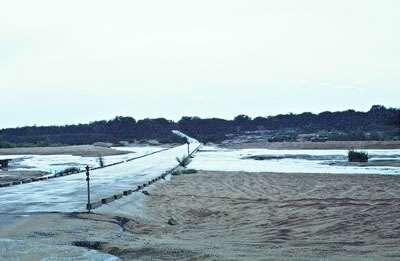
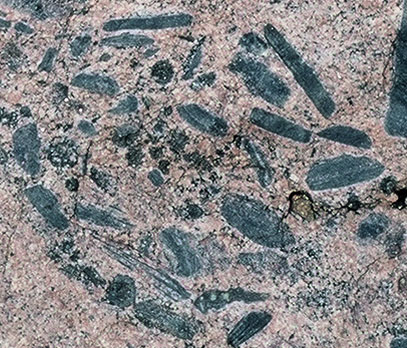
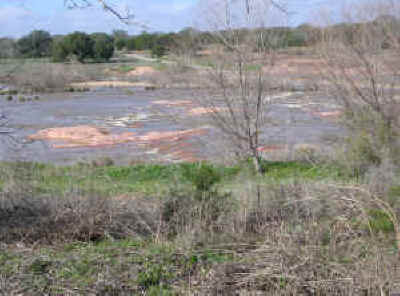
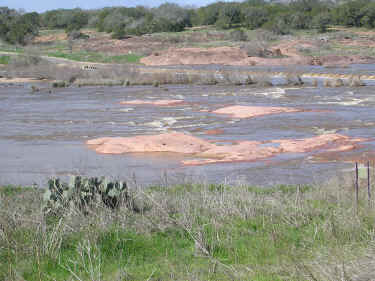
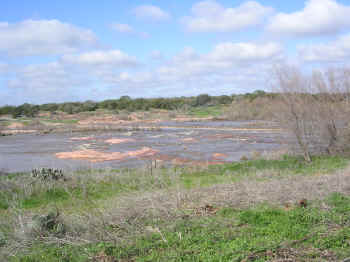
It’s located on FM 3404 that runs from Kingsland west to Rte. 71. I’ve only been to the place twice, and the really remarkable thing is the number of xenoliths there. Other than that it’s a fairly typical example of a coarse-grained porphyritic (Town Mountain) granite from the Llano Uplift. It’s also a fairly typical example of what we call in Texas “a low-water crossing.” There should also be some interesting pieces of the various rock types of the Llano Uplift in the river bed.
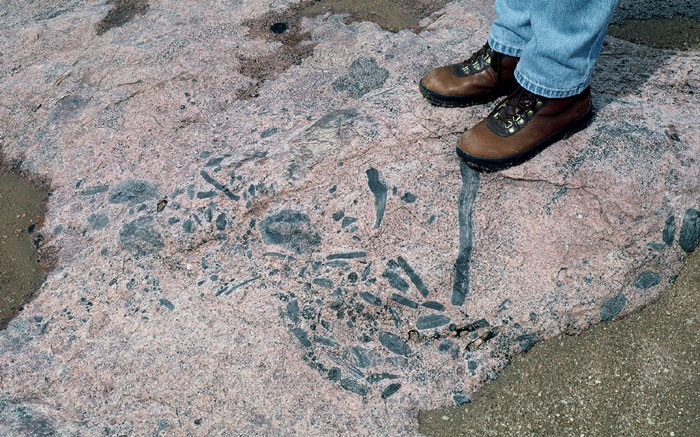
And this would be the reason to go there. The xenoliths are pieces of amphibolite. In some cases the granitic material has invaded the xenoliths along foliation. By the way, those aren’t my feet, so the xenoliths aren’t quite as big as you were thinking.
A little history of our town Kingsland, Texas
Kingsland, Texas was a popular resort town during the peak of recreational railroad travel, then a fire destroyed most of its buildings.Kingsland, Texas is an unincorporated town located in Llano County at the junction of the Llano and Colorado Rivers. It is nestled between the majestic Lookout Mountain, Long Mountain, the Riley Mountain chain and Packsaddle Mountain, and is surrounded by live springs, creeks, and rivers. In addition to its picturesque beauty, the small town of Kingsland is also rich with history.
Early Residents of Kingsland, Texas
The Paleo Indians were the first residents of Kingsland, hunter gatherers who traveled across North America and settled on the banks of the Colorado River where there was easy fishing and plenty of edible plants and game. Later, the Kiowa, Apache, Aztec, Tonkawa, Comanche and other tribes also lived in what is now Kingsland, taking advantage of the rich soil and abundant wildlife. Kingsland harbors a great wealth of historical information in their former camps and hunting grounds. Unfortunately, treasure hunters destroyed many of these ancient camps searching for spear heads. There is, however, a camp site on Lower Colorado River Authority land and the current property owners fenced the camp grounds and installed other security measures, then archeologists from the University of Texas and the Llano Uplift Archeological Society worked together to uncover more than 20,000 artifacts. The site is now known as The Nightengale Archaeological Center.
King and Trussell Families Arrive from Alabama
In 1877, Martin D. King traveled from Alabama with his wife, seven children, and a small herd of cattle. King and his brother-in-law, James Trussell, purchased property in the area and cleared the land of trees and brush with the intention of building a town. Unfortunately, Martin King died in 1883. King’s wife, Nancy Jane Trussell, unwilling to allow her husband’s dream to die with him, formed the Pacific Survey Company then platted, laid out, and named the original streets of Kingsland. The town was named after Martin D. King. In 1884, Kingsland had a population of forty, including the King, Fowler, and Yetts families. It also had a trading post, a cotton gin, a saloon, of course, like most towns in the Old West, and fifteen houses. A post office was established in 1885.
The Railroad Attracts Tourists to Kingsland
According to the Handbook of Texas Online, the Austin and Northwestern Railroad arrived in Kingsland in 1892. Railroad vacations were popular at that time and the railroad started work on The Antlers Hotel in 1900 to accommodate vacationing passengers, many who traveled up from Austin to enjoy the great beauty of the Kingsland area. The hotel was completed in 1901 and was considered very modern because of its gas lights and the telephone in the lobby. In addition to railroad travelers, it also catered to traveling salesmen and cattlemen. By 1907, Kingsland had a population of 750 residents.
A Town Fire and the Automobile Slow Growth
According to Families of Early Kingsland Texas, the popularity of the automobile brought an end to railroad vacations as travelers preferred the privacy of their own vehicles to more public forms of transportation. Ironically, according to Families of Early Kingsland, Texas, the first automobile in Kingsland—a 1915 Maxwell–was owned by Martin King, Jr., the son of the town’s founder. The decline in railroad travel also brought a decline in the success of many tourist-based businesses in Kingsland. The Handbook of Texas Online also reports that in 1922, the City of Kingsland experienced a major fire that destroyed many of its buildings as well as its resort-like atmosphere. The Antlers Hotel closed its doors in 1923. By 1925, the population of the town of Kingsland dropped down to 150.
Local Dams Bring Work to Kingsland Residents
In 1935, Texas Congressman James Paul Buchanan introduced a bill to Congress for a series of dams from Kingsland to Austin to help mitigate the losses from the horrific onslaught of constant flooding–the State of Texas leads the nation every year in flash flood-related deaths.. The first dam and the lake it contained are named after Congressman Buchanan in honor of his efforts to mitigate the flood damage. These projects attracted workers and residents to the area and once again, Kingsland was revived. The construction of the nearby Inks Dam also brought more work, but when the dams were finished, the workers moved on.
Great Beauty and Wildlife Revives the Town as a Retirement Haven
Kingsland was a sleepy little railroad stop for many years. A few businesses remained, along with many of its original loyal families. However, in the 1960s, Kingsland began to see a revival as passing travelers recognized the great beauty of the area and the possibility for creating a comfortable retirement community with opportunities for fishing, boating, camping, and sightseeing. And as it did in the days of the first settlers, the Kingsland area once again appeals to hunters, particularly deer and dove hunters.
Antlers Hotel Reopens its Doors
In 1993, The Antlers Hotel was sold and renovated in a way to preserve its historic importance. It has since reopened and now has an additional unique attraction as a reminder of Kingsland’s origins as a railroad tourist stop–three train cabooses and a coach, all fully furnished to accommodate guests. The Antlers Hotel is a historic landmark and is included on the National Register of Historic Places. The restaurant on the property has a unique history of its own. It was used as the house in the original 1974 film Texas Chain Saw Massacre. The house was moved from its original location to Kingsland where it now serves as an elegant restaurant for guests of The Antler’s Hotel.
Kingsland Thrives Once More
The many lakes and rivers surrounding Kingsland continue to attract retirement and recreational businesses and Kingsland is experiencing a revival. In 1986, it had a population of 1,500. In 1990 the population was 2,725, and the current population is approximately 4900.
Resources:
Heckert-Greene, James B. “Kingsland Texas”. The Handbook of Texas Online. Retrieved November 10, 2009. http://www.tshaonline.org/handbook/online/articles/KK/hjk5.html
Jackson, Muriel Barnett. Ed. Kenyon, Colleen Moore. Families of Early Kingsland, Texas and Nearby Communities in Llano and Burnet Counties: A Collection of Family and Community Histories, Photographs and Documents. Kingsland Genealogical Society. Kingsland, Texas: 1998.
Flash Flood Warning
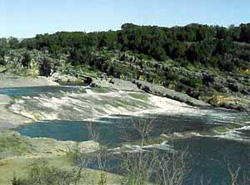
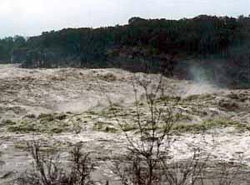
The Llano River running along the camp can flash flood with little or no warning. The water in the river can rise from a placid stream to a raging torrent in a few minutes. If you are in the river area and notice the water beginning to rise, you should leave the river area immediately. Flash flooding is a common phenomenon in the Texas Hill Country, and camp visitors are encouraged to be alert to weather conditions. As an example shown are a before photo of the Pedernales River and a 5 min. later photo, so be careful.
These high water photos taken 02/18/12|
(note water over slab bridge)